WHO EIOS 2.0: What Global Signal Detection Means for Your Post-Market Surveillance
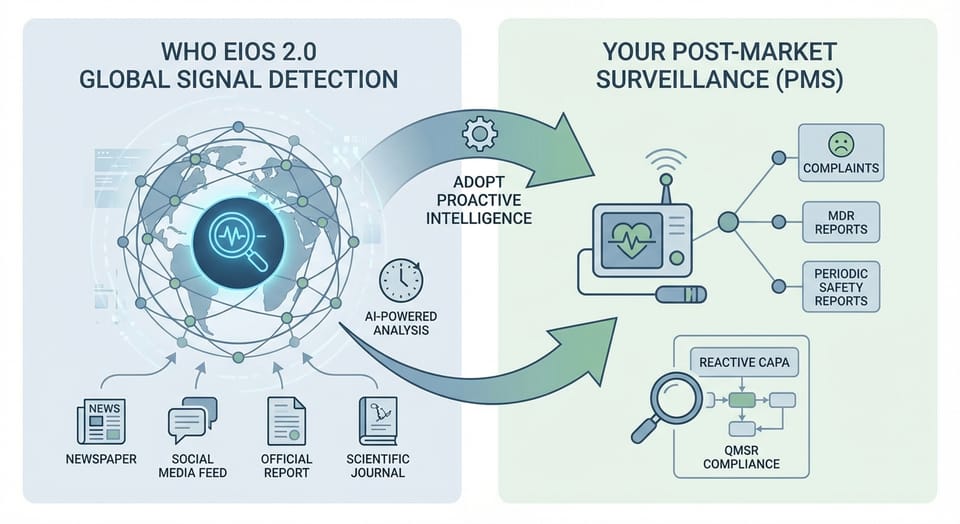
The World Health Organization just upgraded its Epidemic Intelligence from Open Sources (EIOS) platform to version 2.0. If you work in regulatory affairs or post-market surveillance, you probably scrolled past the announcement.
That was a mistake.
EIOS 2.0 isn’t a disease surveillance tool anymore. It’s a real-time global signal detection engine that processes millions of data points from news, social media, official reports, and scientific literature — in multiple languages, across every country.
And it has direct implications for how you manage post-market surveillance under QMSR.
What EIOS 2.0 Actually Does
EIOS was originally built for epidemic detection. Version 2.0 expands its capabilities:
- Multi-source ingestion: News feeds, social media, official government health reports, scientific literature, ProMED alerts
- AI-powered signal detection: Natural language processing identifies potential health events before they’re officially reported
- Real-time dashboards: Configurable by geography, disease category, or keyword
- Collaborative intelligence: 120+ countries contribute and validate signals
The WHO uses this to detect outbreaks before they become pandemics. But the underlying technology — scanning unstructured data sources for emerging signals — is exactly what post-market surveillance should be doing.
The Post-Market Surveillance Connection
Under ISO 13485 Clause 8.2.1 (now incorporated into QMSR), manufacturers must establish a post-market surveillance system that collects and analyzes data from production and post-production activities.
Most companies do the minimum: complaint handling, MDR reporting, periodic safety reports.
But the regulation says "collect and analyze data" — it doesn’t say "only look at your own complaint database."
What If Your PMS System Could Think Like EIOS?
Consider what a signal-detection approach to post-market surveillance would look like:
1. Multi-source monitoring
Instead of waiting for complaints to arrive, you’re scanning:
- FDA MAUDE database for similar-device adverse events
- Published literature for clinical findings related to your device category
- Social media for patient-reported outcomes and off-label use patterns
- International vigilance databases (MHRA, BfArM, TGA)
2. Pattern recognition before trend confirmation
EIOS doesn’t wait for three confirmed cases to flag a signal. It identifies weak signals early. Your PMS system should do the same:
- Two similar complaints from different hospitals in different states — is that a coincidence or an emerging pattern?
- A published case report describing an adverse event with a device in your product family — does that trigger a proactive risk assessment?
3. Geographic intelligence
For companies selling internationally, signal detection by geography matters:
- Is there a cluster of complaints in a specific region that correlates with a specific distributor, sterilization batch, or raw material lot?
- Are international regulators seeing issues with your product category that haven’t surfaced in FDA data yet?
How This Changes Your CAPA Thinking
The traditional CAPA model is reactive: complaint → investigation → root cause → corrective action.
A signal-detection model is proactive: weak signal → risk assessment → preventive action → complaint never happens.
This maps directly to ISO 13485 Clause 8.5.3 (Preventive Action) and aligns with the CSA (Computer System Assurance) mindset: risk-based thinking, not checkbox compliance.
The companies that adopt signal-detection approaches to PMS will:
- Catch field issues 3-6 months earlier
- Reduce the severity of corrective actions (catching issues early = smaller scope)
- Demonstrate proactive risk management to FDA during inspections
- Build competitive advantage through better post-market intelligence
The Practical First Steps
You don’t need to build a WHO-scale intelligence platform. Start here:
Monday morning:
- Set up Google Alerts for your device name, product category, and key competitors + "recall" / "adverse event" / "FDA warning"
- Subscribe to FDA’s MedWatch RSS feed for your product code
- Add MAUDE database quarterly reviews to your PMS procedure
This quarter:
- Map your current PMS data sources against ISO 13485 Clause 8.2.1 requirements — identify gaps
- Add one international vigilance database to your monitoring scope
- Document your signal detection criteria: what constitutes a signal worth investigating?
This year:
- Evaluate AI-powered literature monitoring tools
- Build a signal-to-CAPA pathway into your PMS procedure
- Present signal detection methodology to management review
The Bottom Line
The WHO built EIOS because waiting for confirmed cases costs lives. In medical devices, waiting for confirmed complaints costs recalls, warning letters, and patient harm.
The technology for proactive signal detection exists. The regulatory expectation is there (ISO 13485 Clause 8.2.1 + QMSR). The question is whether your post-market surveillance system is still stuck in reactive mode.
EIOS 2.0 shows what’s possible. Your PMS system should be paying attention.
For a deeper dive into how CAPA effectiveness connects to post-market surveillance, read The CAPA Paradox on QMS.Coach.